During my four years as a student at Clark University, I have witnessed numerous episodes of blatant hostility and hatred towards Israel, both inside and outside of the classroom.
In response, my fellow Zionist students and I used our voices to combat this rhetoric, yet we found ourselves to be standing alone. This experience has shown me that being an active Zionist student leader has essentially functioned as a substitute for institutional responsibility, stepping in to challenge misinformation and misconduct in spaces where faculty and administrators either cannot or will not intervene.
When I first arrived on campus in the Fall of 2022, I knew that campus anti-Zionism was an issue across the country. Besides the occasional “Free Palestine” sticker on a student’s laptop, however, I was relieved to find that this was not a major issue at Clark.
That all changed after October 7, 2023. Israeli hostage flyers that my friends and I put up around campus were torn down, students chanted “there is only one solution, Intifada revolution” at a protest in the middle of campus, and hateful notes were written on a white board outside of a Jewish student’s dorm room.
The response from the University? A single statement condemning antisemitism and Islamophobia that emphasized a need for mutual respect and understanding, and a reminder about the school’s Bias Incident Reporting System that I have yet to observe produce any meaningful results.
Numerous on-campus events have reflected this sentiment. In late November 2023, Clark’s Middle Eastern and North African Students Association held a “Palestine Teach-In” with alumni who use their platform to deny the Jewish connection to Israel and recommend students follow pro-Palestine Instagram accounts that openly support Hamas. No attempts have been made by any University department or office to offer events with more diversity of thought.
Another consequential instance of administrative passivity occurred when a Clark Undergraduate Student Council referendum in support of BDS was approved by the student body in April of 2024. Our Hillel was the only organization seeking to educate students on why BDS is harmful. It was during this time of intense debate over the referendum that I was harassed by several members of the Scarlet, Clark’s student-run newspaper.
These student-journalists attacked me on the Scarlet’s official Discord, claiming I was “not that bright” for supporting Israel and calling me “hella Zionist,” all while advocating for other students to “keep bullying” me.
In response, I filed a bias report and met with the associate Dean of Students, who told me that the incident would be dealt with. Following the meeting, I never received any communication regarding the status of the incident. From that moment on, I realized that the only people actively challenging anti-Zionism on campus were us students.
These experiences reflect a broader institutional pattern of faculty abusing their professorial power to demonize Israel without consequences, perhaps most famously at the Strassler Center for Holocaust and Genocide Studies. It took the public resignation of the Center’s executive director for the University to even acknowledge the possibility that instances of intimidation and harassment had been taking place.
Even just last week, when I organized a tabling event of testimonies of October 7 survivors with 2025 Miss Israel winner Melanie Shiraz, we were met with numerous hateful comments and gestures, including being called Nazis on the anonymous social media app Fizz.
For the University to condemn this blatant Holocaust inversion would be the bare minimum, but after what I have seen over the past four years, I’m not getting my hopes up.
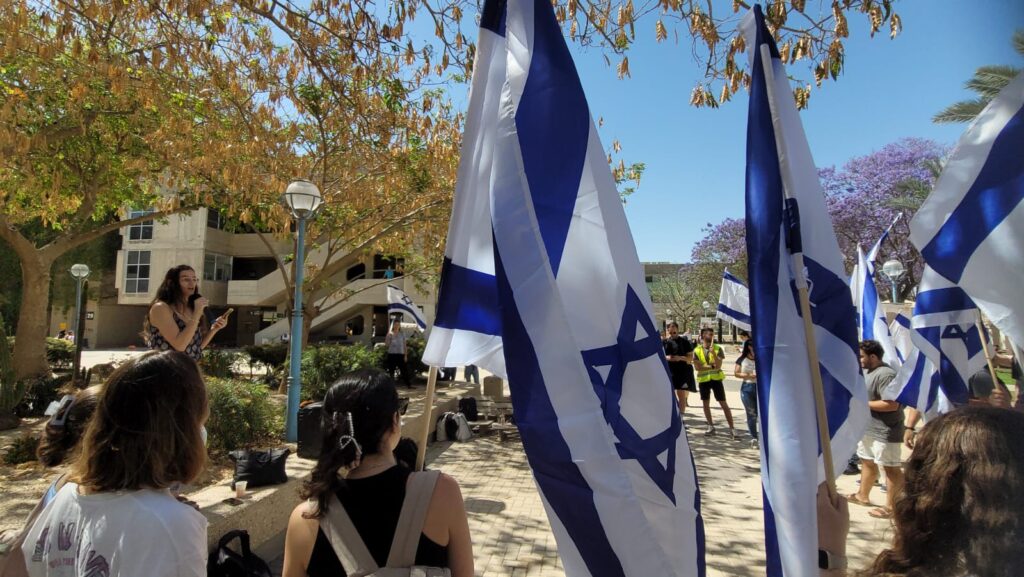
In response to this rhetoric, as vice president and later president of our Hillel, I used my platform to host numerous educational events on understanding contemporary antisemitism, the geopolitics of the Middle East, and how to effectively talk about Israel.
In spite of our efforts, these events simply do not have the same reach as ones sponsored by academic departments or the University itself. It almost feels as if the task of educating others has been placed on me, rather than on the institution whose mission is to “advance the frontiers of knowledge and understanding.”
As I prepare to graduate in the coming weeks, it fills me with disappointment that despite my efforts, Zionist students and staff remain the ones confronting unabashed hatred towards Israel due to the failure of administration. But I have already seen that my fellow students and I have inspired a new generation that is more willing to challenge misinformation, and more dedicated to holding those in positions of authority accountable.
This article was originally published in The Algemeiner. Opinions expressed are those of the author and do not necessarily reflect those of CAMERA.