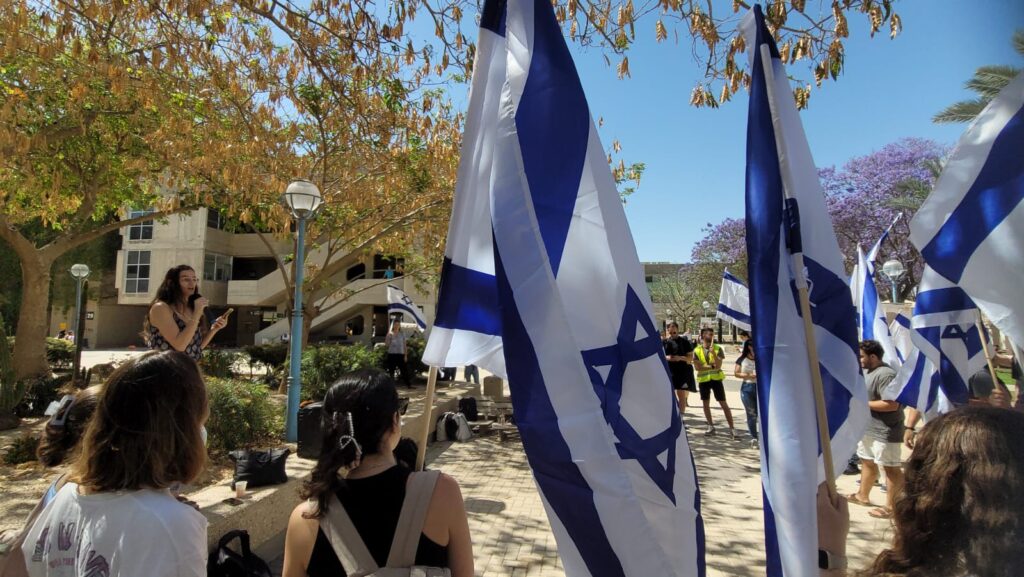
Freedom of speech is a cornerstone of any democratic society and is especially important at universities. When it comes to events related to Israel however, attempts are often made to halt this freedom. This has been pushed by those who hold opposing views, leading to those in positions of authority, such as Students’ Unions (SU) and campus security, to place restrictions on events. Security and safety are often cited as the driving factor behind these restrictions, but is that all there is to the story?
As President of the Israel Society at the London School of Economics, I aim to organise events that promote education and dialogue about Israel. I have brought speakers from across the world to campus to share their unique stories, experiences and perspectives with students. Even after the already difficult task of bringing the speakers to London, finding a date and time, as well as a venue, I have found myself required to navigate significantly more obstacles than any other student society at my university.
Last year, I organised an event bringing Jewish Mizrachi activist Adiel Cohen to campus to share his family’s story of fleeing Yemen and moving to Israel. I submitted all required SU forms well in advance, yet over the following month I was repeatedly questioned about his military service, travel arrangements, and previous UK visits.
Although the event was eventually approved after an additional meeting with the SU, campus security, and senior management, it came with significant amendments. Despite requesting an academic chair, needed to allow external attendees, the SU restricted attendance to internal participants only while still requiring one. After three months of planning, approval to advertise was only granted on the Thursday before a Monday event, leaving just four days to promote it, two of which were over the weekend.
A separate event on how to navigate difficult conversations about Israel on campus was also forced to change venue and be shortened due to security concerns, leaving little time for discussion. Ironically, an event centred on freedom of speech was itself restricted out of fear of disruption.
In both these examples, and many others across campuses, events that aim to speak about Israeli culture and history, or any event which dares to go against the antizionist status quo which exists at the moment, is met with limitations being placed. This is different to how any other student society is treated and constitutes a clear double standard aimed at supressing pro-Israel voices on campus.
This makes me question why the university would address the wrong issue and restrict me whilst allowing the violent mobs to run rampant and intimidate people that disagree with them. The university should focus on the real issue and address these people who break the rules rather than those who follow them. If universities are genuinely committed to freedom of speech, they would act to ensure the event runs smoothly as planned, safe from any disruptions. Instead, I’ve seen attendees blocked from entering and speakers shouted down; exactly the kinds of behaviour that undermine open debate.
Respectful disagreement is healthy. If you oppose a speaker, attend the event so you can ask tough questions and analyze the answers. Protesting is also a legitimate form of expression, but not when its purpose is to silence others. Blocking entry, harassing attendees, or chanting antisemitic slogans crosses the line. Criticism of Israeli policy is fair; antisemitism and intimidation that demands harming millions of Jews are not.
Another example that highlights the clear double standard of how Israel Society is treated compared to every other society was my experience surrounding the Fresher’s Fair last year where I handed out wristbands reading “I Support the IDF” to show my support for the brave men and women who protect my friends, my family, and the country my community represents. Staff members of the SU asked whether this was “appropriate” and urged me to “think about the implications.” They didn’t explicitly tell me to stop, but the message was clear.
Following this, a social media campaign by other student societies calling for the SU and school to reprimand me, and an article was written in the school paper where an SU staff member, who are not supposed to express opinions on any international issues, referred to my stall as a “disgusting act”. This backlash continued when stalls displaying leaflets that both supported and denied the October 7th Massacre were also put up. No action was taken against them despite the SU being made aware at the time.
The situation escalated even further when an anonymous complaint prompted a Students’ Union disciplinary board investigation and subsequent hearing that could have put my society in jeopardy. Without first seeking any explanation from me, the board concluded that “‘I Support the IDF’ could be perceived as supporting military action” and therefore “creates distress for Palestinian students and others.” The investigation argued that “the key consideration is the foreseeable effect on students who already report a sense of hostility on campus,” ultimately finding that the wristbands represented “a significant likelihood of causing distress and contributing to a hostile environment.”
If the mere possibility that lawful political expression may cause emotional distress is sufficient grounds for disciplinary scrutiny, then the standard established here would logically apply to a vast range of political activism routinely tolerated on campus. Virtually every BDS demonstration, anti-Israel protest, slogan accusing Israel of genocide, chant of “Intifada,” or demand for “Zionists off our campus” could likewise be interpreted as creating distress, fear, or hostility for Jewish and Zionist students. Yet such incidents rarely appear to trigger comparable institutional concern.
In my response to the board, I documented multiple examples of anti-Israel activism that had caused serious distress to Jewish and Israeli students, including rhetoric appearing to justify the October 7 massacre as “resistance” and public denial of Hamas’ documented sexual violence. None resulted in disciplinary proceedings. This is not the first time LSESU has failed to act upon reports of antisemitism.
While the board further insisted that the matter was “not an investigation into the political legitimacy of views,” the investigation’s neutrality claim collapsed under its own reasoning. Throughout its analysis, the board repeatedly adopted and legitimized the complainant’s anti-Israel framing by relying on highly contested accusations that the IDF was committing “genocide” in Gaza while simultaneously treating support for the IDF as uniquely suspect political expression. To do so while denying that it was evaluating the legitimacy of the underlying political position demonstrates either a profound level of institutional self deception or outright ideological bias.
The contradictions did not end there. The investigation attempted to distinguish between protected “political opinions” and “promoting a foreign military organisation,” arguing that support for the IDF was “not protected in the same way.” Yet the same Students’ Union had previously defended events presenting Hamas in a positive light, a proscribed terrorist organisation, under the principles of free speech and academic freedom.
As my response noted, it is difficult to identify any principled basis on which support for the armed forces of a recognized sovereign state could be treated as more institutionally suspect than discussions involving an internationally recognized terrorist organization.
Perhaps most remarkably, the investigation omitted the fact that senior SU staff had already confirmed to me that both the wristbands and the other activities under investigation, including placing pro Israel stickers over BDS rally posters, fell within my rights to freedom of expression. My response, which members of UKLFI helped me prepare, reminded the board that the Students’ Union was under a legal obligation to protect lawful speech under the Higher Education and Research Act and that “distress caused by encountering a political opinion one disagrees with is not, in law, a sufficient basis for restricting freedom of expression.”
Shortly afterward, the disciplinary proceedings were abandoned entirely. It is scary to think that I needed to involve legal expertise to convince the SU against violating my rights.
Universities too often choose the path of least resistance, restricting those who follow the rules instead of confronting those who repeatedly break them to shut down debate – particularly on Israel. Society leaders are students, not full-time administrators, and cannot be expected to endlessly rework events while being treated as the problem. While Students’ Unions and security cannot please everyone, decisions driven by fear of backlash undermine fairness and free expression. The solution is straightforward: engage early with societies, be transparent about risk, and place consequences where they belong, on those who disrupt, not those who comply.
This article was originally published in the Times of Israel Blogs. Opinions expressed are those of the author and do not necessarily reflect those of CAMERA.