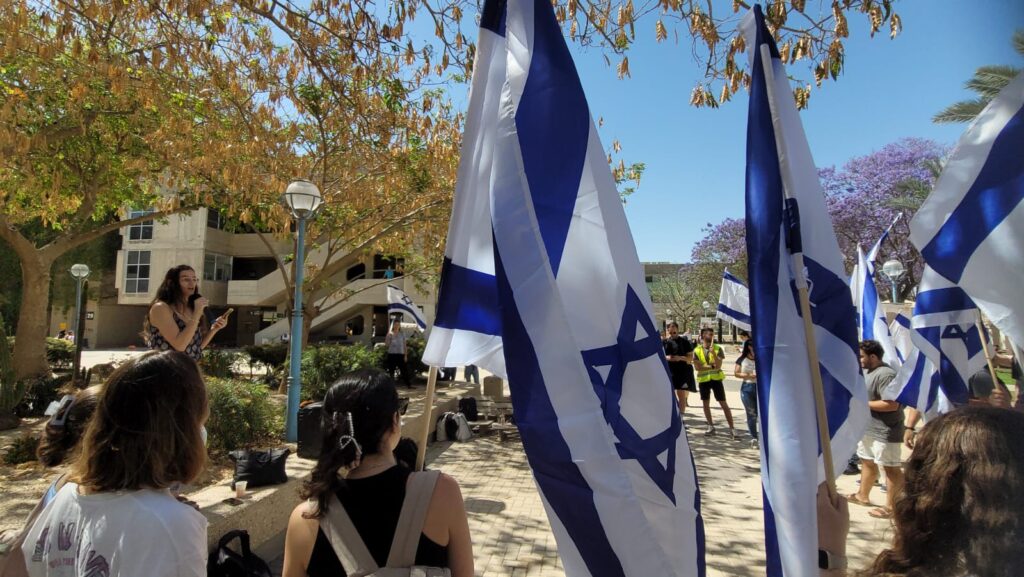
A recent episode at SUNY Buffalo (UB) suggests that higher education is once again exhibiting some of its ugliest tendencies regarding Jews.
In April, the local Zionist student group hosted an educational event featuring Israeli veterans sharing their stories of surviving October 7, 2023. The scene quickly devolved into chaos when more than 170 angry protestors attempted to shut the event down.
Protesters surrounded the building, blocked people from entering, and overwhelmed the room with genocidal chants rife with expletives until police escorted some of them outside.
Parents who attended the event described the intrusion as a coordinated intimidation campaign rather than a campus protest. The event was forced to end early.
Organizers say that shortly before the event, university officials reversed their earlier approval of the group’s pre-registration system, requiring them to admit anyone who wished to attend, including several individuals who had initially been denied entry due to a history of event violations.
Campus police eventually removed multiple disruptive protesters after their behavior escalated, releasing them outside the venue. There has been no indication of any disciplinary action.
Participating activist groups later celebrated the disruption online with slogans like, “There’s more of us than them!” and “IDF OFF OUR CAMPUSES!”
A mob bullying Jews wasn’t viewed internally as a shameful minority of zealots in an otherwise legitimate movement, but as righteous underdogs resisting complicity to what they believe is an absolute evil.
Allowing Jews, Israelis, and Zionists an equal seat at the table cannot seriously be reframed as an act of oppression against Palestinians, no matter how emphatically a subset of the community declares it to be.
Meanwhile, UB’s administration remained silent, and the only coverage in the student newspaper framed the controversy around Palestinian students’ discomfort rather than the effort to shut the event down and intimidate attendees.
The anti-Israel activists’ conduct appeared to violate articles 3 and 5 of UB’s code regarding disruption, harassment, and interference with school-sanctioned events. Such Blackshirt-style tactics should have no place in a university, let alone Western civilization.
UB previously dealt with a similar situation during their 2024 anti-Israel encampments, when police ultimately needed to disband the crowd, leading the school to declare stricter official time, place, and manner policies. These standards appear to have since been ignored.
Over 200 faculty members voiced their support for the students involved in the encampments, and there is reason to believe that some faculty even participated.
Attendees of the April 2026 event allege that a staff member of UB’s Equity, Diversity, and Inclusion committee who is a known affiliate of the self-identified “Buffalo SUNY BDS” activist group helped coordinate aspects of the disruption.
There is also growing concern that extremist professors have been using their classrooms to pressure students into adopting their ideological views.
This is the same university where a student was arrested for attempting to incite a mass shooting of the local Hillel, against the backdrop of a broader history of swastika vandalism and violent anti-Zionist graffiti.
UB leadership knows all of this and still appears to operate under the assumption that enough accommodation and patience will calm tensions — or, their internal politics have become so toxic that reasonable administrators are powerless. At a certain point, much of the Jewish community will have to accept the fact that the school either cannot or will not take this situation seriously.
When Jewish students are welcome only so long as they distance themselves from Zionism, remain quiet about Israel, or suppress visible parts of their identity, then something has gone deeply wrong.
After all, if the conflict is often characterized as an ongoing genocide, there is no real endpoint here short of total supremacy. That mentality increasingly encourages these anti-Israel activists to channel their frustration and moral fervor toward accessible symbolic targets, casting local “Zionists” and their institutions as proxies for a conflict they cannot hope to resolve from a quad in Buffalo.
Rather than continuing to wait for the other shoe to drop and hoping that eventually the right people will make the right decisions, a change in strategy may be necessary. Building collaborative relationships with administrators and faculty remains worthwhile, and the community leaders who have invested in such efforts deserve continued support. But protecting Jewish campus life will likely depend on a greater willingness to organize more educational events about Israel, engage in student government, strongly denounce the anti-Israel crowd every time they cross the line, and challenge institutional double standards in the public square.
That means writing letters, publishing op-eds, and building a social media presence that keeps Zionist perspectives in the public conversation. If local news outlets like the Spectrum and Buffalo News continue refusing to publish submissions from Zionists, establish new ones.
We all have a duty to act. The tyranny of small concessions exacts a heavy toll.
This article was originally published in The Algemeiner. Opinions expressed are those of the author and do not necessarily reflect those of CAMERA.