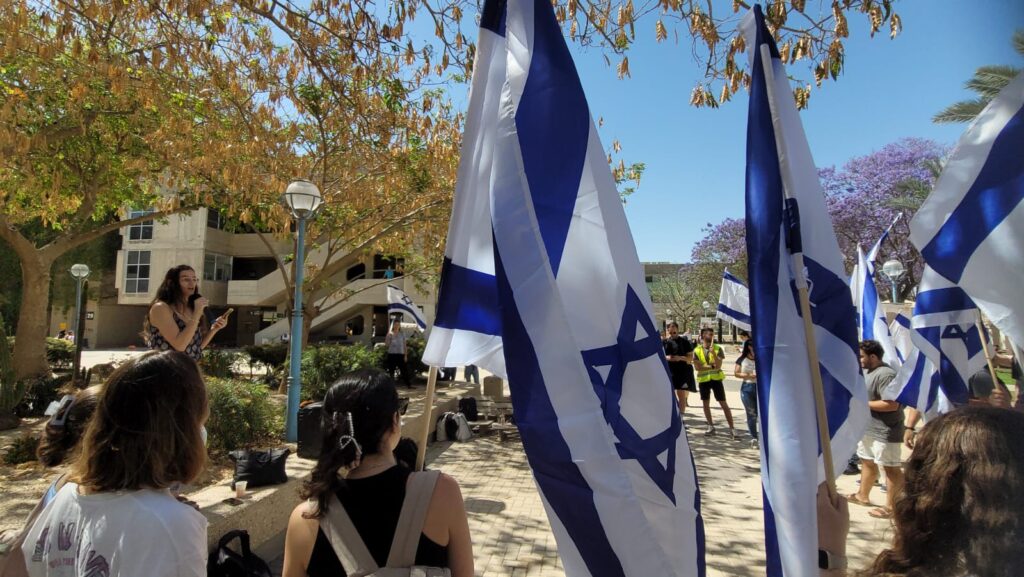
Despite not having started university yet, I have already seen what Jewish students can face on British campuses.
In May 2024, I went with a friend to look at the encampment at the University of Manchester. We approached the information tent and explained that we were Jews who wanted a dialogue. Rather than speaking to us, the protestors refused and instructed others to do the same.
Later that year, I attended a debate at Manchester titled “Is Anti-Zionism Antisemitism?”, where anti-Israel protesters disrupted the event and nearly caused it to be cancelled. Then, in June 2025, I attended an open day at the University of Leeds, where I will begin studying this September. I was met with another encampment, the occupation of a university building, and chants of intifada. Police looked on and told us there was nothing they could do, despite staff and prospective Jewish students feeling intimidated.
These experiences made me realise two things. The first was that I was almost certain to face antisemitism at university, especially at Leeds, where the Hillel House has been vandalised and the Jewish chaplain was forced into hiding. The second was that I was not prepared to stand by and let that hate continue. I knew that, one way or another, I was going to be a voice for Zionism when I arrived on campus.
What I did not yet know was what effective advocacy would actually require.
British Jewish students entering university can often feel that they have only two options: keep their heads down or prepare for a thankless fight. My experience at CAMERA’s International Student Leadership Conference in Boston showed me a better alternative. We can stand firmly in who we are, learn how to persuade those willing to listen, and make sure we are never left to confront hostility alone.
Out of everywhere I thought I would travel during my post gap year summer, Boston was not especially high on the list. However, when the CAMERA (Committee for Accuracy in Middle East Reporting and Analysis) student fellowship was posted in a WhatsApp group I was part of, applying felt like a no-brainer.
CAMERA challenges misinformation about Israel. Its campus fellowship supports students advocating for Israel at universities around the world.
I was quite unique among the attendees at this conference. Everyone else had completed at least one year of university, while I will only begin this September. Yet the concerns being discussed did not feel distant. I had already seen the hostility students described, and I knew I could soon face it myself.
Many stories shared during the conference involved antisemitism, intimidation, and universities failing to protect Jewish students. However, some of the stories that stayed with me most were about the positive results campus activism can produce. Participants spoke about receiving media attention for their work, changing other students’ minds for the better, and organising events that had a real impact on their university communities.
It was also incredibly positive to meet Christian allies who had chosen to stand with Jewish students after witnessing how rife antisemitism had become following October 7. Their presence affirmed to me that Jewish students are not the only people who recognise what is happening, and that standing against antisemitism should not be a Jewish responsibility alone.
The most important lesson for me, however, was CAMERA’s dedication to teaching us not only how to counter anti-Israel narratives, but how to understand them.
Several speakers returned to the same message: if we want to change opinions and correct misinformation, we need to listen. We need to make people feel heard, understand the argument they are making, and respond to it rather than simply waiting for our turn to speak.
That does not mean accepting lies or excusing hostility. It means recognising that advocacy cannot only be about knowing the facts or shouting them more loudly. It must also be about communicating in a way that another person can receive.
This is something I have tried to commit myself to since returning to the UK from my gap year in Israel. A couple of months ago, I was handed a leaflet in Liverpool about “Israeli apartheid”. Although I strongly disagreed with the person giving it out, I still chose to engage in a respectful conversation. Instead of both of us walking away exhausted from a shouting match, we ended on a civil note, with each of us having gained some perspective.
Of course, not every conversation will be civil. Some people are not interested in dialogue and will choose intimidation instead. The conference did not pretend otherwise.
That is why I was grateful to hear from Six13 Guard, a nonprofit security organisation in America, which gave us practical advice about staying safe while holding events on campus. The British students also met with UK Lawyers for Israel, which explained our rights, what universities are required to do, and what steps we can take if those rights are not respected.
These sessions mattered because confidence without preparation is not enough. Students need to know how to have difficult conversations, but also how to protect themselves, document what happens and challenge institutions when they fail in their responsibilities.
Most importantly, the conference showed me that none of us has to do this alone.
When I arrive at Leeds, I know that antisemitism, anti-Zionism, and hostility towards Israel will not simply disappear. I do not expect every conversation to end well, or every event to change minds. But I will arrive with more than the determination to fight back. I will have the knowledge to communicate effectively, the confidence to stand firmly as a Zionist, and a network of fellows and CAMERA staff ready to offer advice and support.
Before Boston, I knew that I would refuse to remain silent. After Boston, I have a clearer understanding of what speaking up should look like.
It means knowing the facts, but also knowing how to listen. It means being willing to engage, but also recognising when someone is trying to intimidate rather than talk. It means standing firmly in who we are without believing that we must stand alone.
this article was originally published in the Jewish Telegraph Group of Newspapers