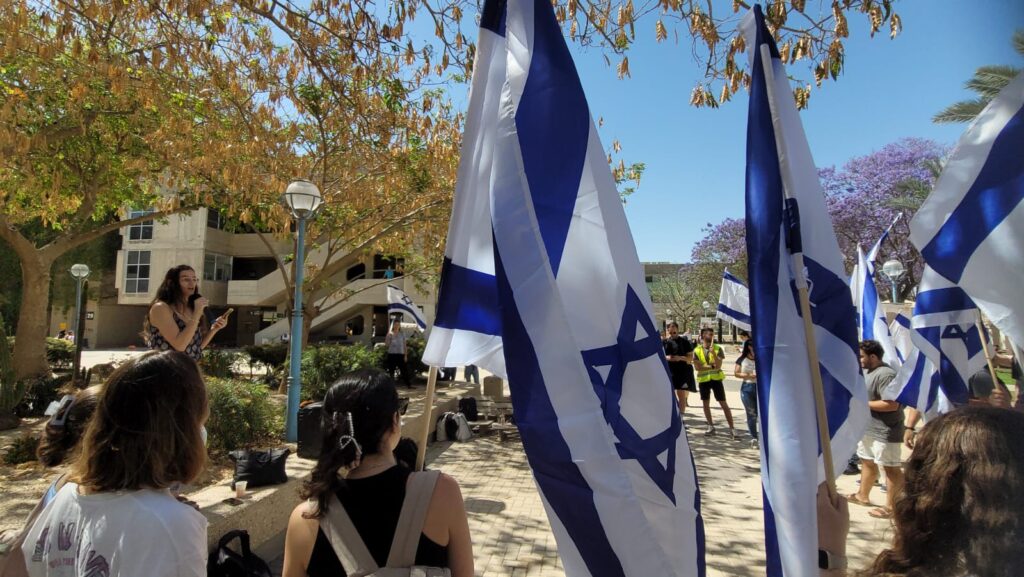
As this school year comes to a close, it’s clear that antisemitic incidents across University of California campuses are not following suit, but escalating. From protests against former hostages to promoting suicide bombers, and targeting Jewish students online, antisemitism is alive and well, as it has been for years. Regardless of the different faces antisemitism wears, these are not isolated incidents. They point to a larger, more uncomfortable truth that antisemitism is not a relic of the past, but rather is adapting to the present.
Actions that are often framed as “anti-Zionism” on college campuses across America are increasingly showing up as a socially acceptable mask for antisemitism. These incidents are seeping into Jewish spaces and targeting Jewish students and identities in ways that are becoming concerningly normalized and dismissible.
Just last month, Omar Shem Tov, an Israeli hostage who survived 505 days of torture in Gaza, came to speak at UCLA and was greeted with a host of antisemitic protesters. He faced the hostility of crowds, treated as if he himself were a terrorist, not a victim of them. The UCLA Undergraduate Student Association council claimed that hosting a survivor of Hamas captivity was “obscuring the broader reality of ongoing state violence.” As if to say that offering students a chance to develop some empathy toward the suffering of Israelis caught in the middle of the war is somehow an attempt to spread prejudice against Palestinians. Ironically, their stance suggests that the exact opposite has already taken root.
Despite this reaction, Omar still pulled in his message that even after experiencing the unimaginable, his message promotes empathy and humanity. “You can’t fight darkness with darkness, you have to bring in the light.” Although the negative reaction at UCLA was widely publicized, other campuses greeted him with compassion and understanding.
In stark contrast with UCLA students’ problematic reaction, UC Berkeley thought it would be appropriate to host a failed Palestinian suicide bomber to deliver a speech to students for a “Palestinian Political Prisoners Day” event during the same week. It’s worth noting that she wasn’t some freedom fighter targeting a military site; the woman was arrested after attempting to ignite a car bomb near a civilian neighborhood and was heard shouting the Islamic Supremacist call to violence against infidels, “Allahu Akbar.” The mass murder attempt severely disfigured herself and the Israeli police officer who confronted her.
This clearly crosses from political discourse into moral distortion, and it raises questions like: Why is violence against Israelis, and by extension Jews, being normalized? Why are we praising martyrs? And how have we come to live in a world where suicide bombers are praised, and former hostages are shamed?
Meanwhile, throughout April, at UCSB, Hillel was busy promoting their most exciting event of the year, a Jewish prom. Despite promoting an event that was only meant to bring joy and fun to the community, Hillel was met with a host of online antisemitism. Comments like “Will there be a bomb dropping simulation?” It seems that the Jewish community can barely do anything without some anti-Zionist taking issue. The event went on as planned, albeit with unprecedented additional security and emotional distress placed on the student planning committee.
If anti-Zionism is not bigotry against Jews, what exactly does targeting a social for Jewish students have to do with Gaza? As most people are able to agree about bigotry, antisemitism does not need to be physical violence to produce real harm.
Universities are supposed to protect political free speech, but antisemitism stops being protected political expression when Jewish students are targeted, threatened, harassed, and blamed for the actions of the state of Israel. This line matters because free speech should encourage debate and protest, not cross the line into normalizing intimidation or hatred toward an entire group of people.
Whether it’s protesting against former hostages, justifying or celebrating violence, or online harassment and intimidation, antisemitism continues to embed itself into the culture of college campuses. The AMCHA Initiative has a database of over 11,900 incidents of antisemitism on over 700 campuses. This issue is much larger than three California campuses; it exists across the nation in every place that Jews do.
Despite this, it’s more important now than ever for Jewish students to remember Omer Shem Tov’s message: we need to bring in the light. We cannot afford to flinch as we face the abyss. Continue to host events, choose visibility over fear of bullying, and help build your community so that the next 1st year wearing a Magen David or an Israeli Flag yarmulka has a community to run to when chased across campus by “activists.” Jewish joy has become our strongest form of resilience and is itself an act of resistance. Jewish students belong on college campuses as much as anyone, and we aren’t going anywhere.
This article was originally published in the Jewish Journal. Opinions expressed are those of the author and do not necessarily reflect those of CAMERA.