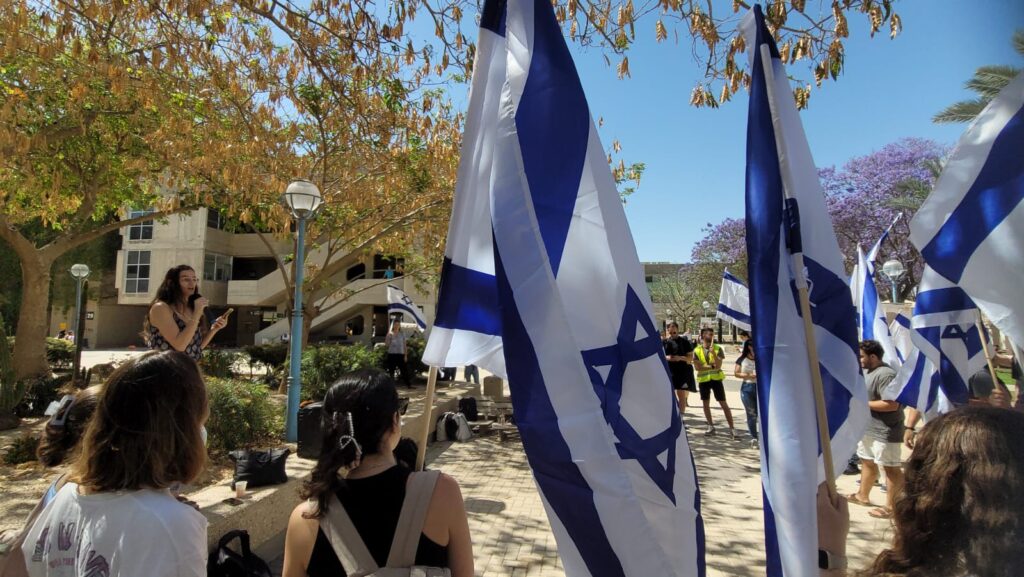
During a pro-Israel event organized by Students Supporting Israel at Toronto Metropolitan University (SSI) held on November 5, 2025, a group of activist students affiliated with Students for Justice in Palestine (SJP) forcibly entered the building. The activists chanted severe incitement slogans toward the participants, including “Zionist murderers,” while smashing the glass doors of the hall and assaulting attendees, among them Israeli reserve soldiers who were present at the event. As a result, several participants were injured and the event was shut down.
The slogans voiced by the demonstrators rely on a common claim in pro-Palestinian discourse, according to which Israel is committing “genocide” in Gaza. Genocide is defined in the 1948 United Nations Convention on the Prevention and Punishment of the Crime of Genocide as an act committed with intent to destroy, in whole or in part, a national, ethnic, racial, or religious group. At the same time, the 1949 Geneva Conventions governing the laws of war establish that even during armed conflict there is an obligation to distinguish between combatants and civilians and to take measures to minimize harm to the civilian population. Accordingly, since Hamas forced the war upon Israel on October 7, 2023, the Israel Defense Forces (IDF) have taken a series of steps to reduce harm to civilians: already during the first week of fighting, warning leaflets were distributed calling for the evacuation of residents from the southern Gaza Strip. This measure was repeated during the expansion of the military operation in Rafah in May 2024, as fighting spread to additional areas, and again with the launch of “Operation Gideon’s Chariots” in May 2025. These steps were accompanied by phone calls to civilians, the opening of humanitarian corridors, and the provision of medical aid to the wounded. In this way, the State of Israel has sought to minimize harm as much as possible to Palestinian civilians in the Gaza Strip who are not affiliated with terrorist organizations. Moreover, since the beginning of the war in October 2023, Israel has approved and facilitated the entry of more than 100,000 humanitarian aid trucks into the Gaza Strip.
Against this distinction between inflammatory slogans and the reality on the ground, the manner in which TMU President Dr. Mohamed Lachemi chose to frame the incident stands out. On November 17, 2025, he published an official statement condemning the harassment at the event and describing it as “acts of aggression, intimidation, and harassment,” while emphasizing the university’s commitment to “respect, safety, and belonging for all.” He stated that the incident was still under police investigation and that the university was cooperating, but refrained from specifying who was responsible for the violence. He stressed that the university could not comment on “specific suspects or potential outcomes of the investigation,” thereby presenting the incident as one that remained shrouded in uncertainty.
Dr. Lachemi’s statement illustrates a profound moral failure in confronting direct and violent antisemitism on campus. Although he highlighted the university’s involvement in anti-antisemitism training and meetings with members of the Jewish community in the city, when Jewish students were harmed and humiliated due to a legitimate democratic organization exercising their identity and freedom of expression, the president avoided issuing a clear and explicit condemnation or framing of the incident as unequivocally antisemitic.
Furthermore, the gap between the language of the statement and the facts already known at that stage raised serious questions regarding the framing of the incident and the way the president chose to present it. As early as November 6, 2025, one day after the event, Toronto Police announced that five suspects had been arrested and charged with forcible entry and assault, some also charged with assaulting a police officer who attempted to make an arrest. Among those arrested was Kabil Ibrahim, 26, who shattered a glass door at the event using a sharp object, assaulted a participant who tried to stop the violence, and fled the building while the chaos continued. Ibrahim, who was subject to a release order in connection with previous charges from April 2025 for burning an Israeli flag and possession of incendiary materials, was one of a group of protesters defined by police as an “unlawful masked gathering.” In addition to him, Nicole Bayton McOakville, Kiana Alexis, and Fatima Mogni were arrested that evening and charged with forcible entry and unlawful assembly at the TMU event.
Instead of clearly pointing an accusing finger at the attackers—whose identities were already known—expressing genuine solidarity with the Jewish students who were harmed, and warning of severe punishment to deter the next attacker before acting, Dr. Lachemi chose softened and vague language that spoke of prohibiting “general violence” on campus, while drawing a false equivalence between antisemitism and Islamophobia and anti-Palestinian sentiments.
To understand why Dr. Lachemi’s framing is problematic, it is important to note that he chose to place the terms “antisemitism” and “anti-Palestinian” in the same sentence, as parallel categories of harm that must be condemned. This juxtaposition creates a false equivalence between two concepts that are not symmetrical. The IHRA definition of antisemitism focuses on hatred and incitement against Jews, while explicitly emphasizing that criticism of Israel and support for the establishment of a Palestinian state are legitimate positions as long as they do not deny Israel’s right to exist or demonize Jews. By contrast, discourse around “anti-Palestinian” sentiment in Canada sometimes expands the term to include pro-Israel political positions and even recognition of Israel as a legitimate state as a moral problem, in line with definitions such as Anti-Palestinian Racism (APR), which broaden the concept of “racism” to include political disagreement, criticism of pro-Palestinian organizations, or challenges to Palestinian narratives such as the Nakba. Therefore, placing antisemitism and anti-Palestinian sentiment within the same moral framework blurs the distinction between protection from ethnic-religious hatred and legitimate political debate. It is important to emphasize that in the case at hand, the harm was directed toward Jews, not toward Muslims or Palestinians. Including the term “anti-Palestinian” in the official statement does not arise from the circumstances of the event itself, but rather creates an equivalence that does not align with the factual reality. This equivalence may weaken the response to cases in which Jewish and Zionist students experience harassment and antisemitism on campus.
This is not an isolated failure, but a symptom of a deeper problem in TMU’s administration regarding incidents related to Jews and Israel on campus. Approximately two weeks after the October 7, 2023 massacre, a letter signed by 74 students was published at TMU’s Faculty of Law, claiming that “Israel is not a state,” condemning its actions as “genocide,” expressing support for “Palestinian resistance” in a manner perceived as justifying Hamas’s actions, and issuing an ultimatum demanding that the university adopt an anti-Israel stance. TMU’s response amounted to a general statement that “the letter does not represent the faculty’s values” and that “statements justifying violence contradict the values of respect and inclusion.” In practice, the response avoided addressing the severity of the antisemitic content itself, including the denial of Israel’s existence and the justification of terror, without taking disciplinary measures or issuing a clear condemnation.
TMU’s weak handling of the letter did not end there. In September 2025, Prof. Sarah Morgenthau, a Jewish lecturer at TMU’s Faculty of Law, filed an appeal to court against the letter, arguing that its signatories encouraged violence against Jews and denied Israel’s right to exist. A Canadian court decided not to intervene in TMU’s decision regarding the suspension of the students who signed the letter, thereby effectively clarifying that statements justifying Hamas’s attack or undermining the very existence of Israel do not exceed the bounds of the academic code of conduct. It should be noted that approximately one month after that appeal was dismissed, the attack against Israeli and Jewish youths at TMU took place.
This pattern is not disconnected from context; it is part of a broader process of rising antisemitism in Canada. According to a report published by the Ministry of Diaspora Affairs in 2024, a 670% increase in antisemitic incidents was recorded in Canada compared to 2023. Jews, who constitute less than 1% of the country’s population, are the most targeted minority, accounting for 70% of all religiously motivated hate crimes, with a likelihood of being harmed 25 times higher than any other demographic group in the country.
These figures illustrate that the threat of antisemitism is not a series of isolated incidents, but an ongoing reality that also obligates Canadian universities to demonstrate genuine responsibility toward Jewish students. These students have the right to feel safe, to express their identity, and to organize in pro-Israel organizations without fear. An academic institution that does not ensure this abandons its students and undermines the values it claims to represent.
This is a wake-up call for academic leaders: obscuring or ignoring antisemitic violence is a moral and educational failure. Combating antisemitism must be placed at the top of the priority list, and it must be ensured that campus events take place in a safe and protected environment. Only a firm and explicit policy will restore a sense of security and establish the campus as a place that truly protects all of its students.
This article was originally published in Hebrew & in Gate Keepers.