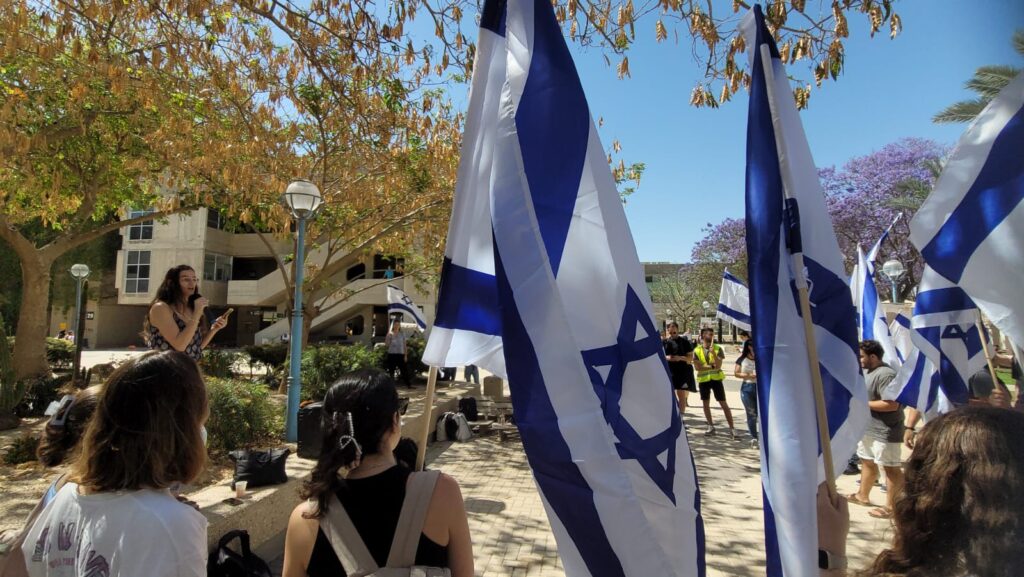
On Oct. 7, 2023, I woke up to my worst nightmare: thousands of terrorists had flooded into Israel and massacred what, at the time, was estimated to be around 1,500 people. My heart sank.
The ever-looming threat of antisemitism that Jewish kids learn about in textbooks, that my grandfather warned me about, was no longer history — it was happening now.
On Oct. 13, 2025, the remaining Israeli hostages came home. After 736 days — two full years — Omri Miran, David Cunio, Nimrod Cohen, Rom Braslavski, Guy Gilboa Dalal and 15 others were released from captivity. The body of our last hostage, Ran Gvili, was returned Jan. 26. This should feel like an ending, but it doesn’t.
In the 842 days since Oct. 7, I’ve watched the world transform. Or rather, unveil itself. After that day, I saw a visceral hatred emerge from its 70-year hibernation since the Holocaust. Suddenly, my community and campus erupted with varying displays of hateful rhetoric: chants for globalizing the intifada, glorification of terrorism and silence in the wake of growing antisemitism.
Physical demonstrations ran parallel to a social media war. My friends were doxxed and digitally harassed. Oct. 7 began to get painted as “propaganda.” This polarization manifested in a palpable shift in how we view and speak to one another — or rather, in how we refuse to.
As a Jewish and Zionist student, the reaction I have witnessed in our generation following Oct. 7 has been one permeated by intolerance, extremism and the utter abandonment of nuance. The Zionist narrative — possessed by 85% of American Jews as of 2024 — has not only been ignored but weaponized to depict us as evil, ultimately leading to a swell in antisemitic violence.
Our generation has lost the capacity for civil discourse.
We need to bring nuance, discourse and tolerance back to our conversations. We need to be challenged, pushed beyond our comfort zones and forced to confront perspectives that differ from our own. These values are what college is about. Holding signs and glaring at one another will not rebuild trust in our generation.
I watch as professors, peers and community members speak about this conflict as if it is theirs to define, protest and refute. They distort Zionism beyond what it was ever intended to represent. Unlike what you may see on Instagram or on posters at a protest, Zionism does not connote settler colonization or ethnic cleansing. Zionism is the right of the Jewish people to self-determination in our ancestral homeland after millennia of persecution and displacement.
If there were still space for dialogue, I would tell people how deeply misunderstood I feel by the world and how estranged I feel from the progressive movement I once aligned with. I would tell them there are 3,000 years of history in that land between peoples that they know next to nothing about. I’d tell them that a few Google searches do not make them qualified ambassadors for this conflict. That, if the blood of the ancestors who fought and died for that land doesn’t run through their veins, they should get out of the streets and get on the phone with their Jewish and Palestinian friends.
During the Black Lives Matter movement, our campus displayed an outpouring of support for the Black community. President Aoun released numerous statements in solidarity with the Black community, implemented university-wide training on cultural and racial literacy, and paused classes for a Day for Reflection, Engagement and Action.
Our campus learned to listen, reexamine our assumptions and give Black voices the space to define their own experiences.
Well, the Jewish people are talking. We are screaming for recognition, for understanding. We are trying to tell the world that this situation is not as simple as the slogans chanted on our campus quads suggest. While you call for “globalizing the intifada,” Jewish students’ parents call them to come home because their campus is no longer a safe place for them.
It’s our conflict, our history, our identity — and yet, you’ve silenced us. You’ve tokenized the small percentage of Jews who agree with you and dismissed the rest of us as complicit or guilty.
Sometimes, I fear that this polarization has surpassed the point of repair; too much has changed. Over the past two years, the curtain has been pulled back, and I’ve seen too much hate, too much intolerance and too much hypocrisy, and I’m not sure I’ll ever see my peers the same way again.
But this is not the future any of us want. This is not the future I’m willing to be complicit in.
We need to revive nuance, discourse and tolerance in our conversations, so that disagreement doesn’t end in hostility, but in mutual understanding. College should be a place where we can challenge one another, expand our worldviews and confront our internal assumptions — even if we get offended along the way. Growth comes from engagement, not antagonism, and from conversation, not intolerance.
This doesn’t mean abandoning your principles or refusing to criticize policies you disagree with. It means approaching these conversations with humility, recognizing complexity and being willing to listen to the people whose lives are at stake. It means understanding that for Jewish students, the question of Israel isn’t an abstract political debate — it’s about our family, our history, our DNA.
The Jewish people have survived because we remember. We carry our history in our bones, in our collective memory of persecution and resilience. But we have also survived because we have refused to let hatred consume us, because we have continued to believe in the possibility of coexistence and understanding.
I’m asking our campus community to believe in that possibility, too. Not someday, not after this conflict ends, but right now. Because if we can’t talk to each other here — in this place dedicated to learning and growth — then where can we?
The hostages are home. But we’re not. Not until we find a way back to civility.
This article was originally published in Northeastern University’s The Huntington News.