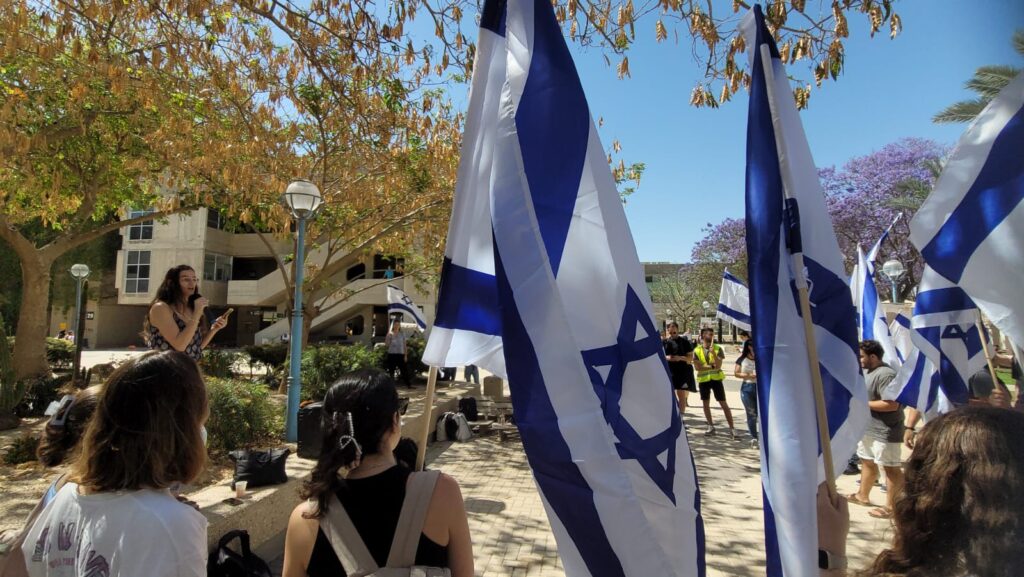
If I am not for myself, who will be for me?
As early as the Babylonian period, Hillel the Elder emphasized the importance of self-support, taking responsibility for one’s own needs as a foundation for recognizing and attending to the needs of others, without slipping into selfishness, and acting with urgency rather than delay. This teaching resonates with my own journey in fighting antisemitism.
Growing up openly Jewish in the diaspora, I have always been conscious of antisemitism. Participating in a youth movement fostered pride, purpose, and education, giving me confidence to discuss Israel and Judaism with non-Jews despite initial fear of judgment.
Antisemitism has adapted to today’s polarized politics. On the right, far-right nationalism in Europe revives old antisemitic tropes; on the left, particularly in academic spaces on university campuses, we see anti-Israel activism giving rise to hostility towards Jews. Antisemitism is being excused as intellectual discussion, with no real penalties.
A survey run by The Intra-Communal Professorial Group , where 497 Jewish students from more than 80 universities in the UK found that 70% are guarded about their Jewish identity and 63% avoided parts of the campus as they feared being insulted, harassed, or demonized. The findings also point to a troubling pattern of institutional complacency that has left universities at risk of normalizing antisemitism.
Most recently, at my own University, City St George’s, University of London, an Israeli Professor of Economics experienced an intimidating and targeted antisemitic attack by masked assaulters, on the basis of his national origin, religion and mandatory service in the IDF. The presumed students openly threatened to behead the man in front of his students during a lecture. The university was unable to identify those responsible for the attack. While it did increase security on campus and issue a statement condemning the incident, these measures did not directly address the broader climate in which the attack occurred. In particular, there was no explicit engagement with the role of protest activity in motivating the incident, nor consideration of measures such as restrictions on face coverings during demonstrations.
In the professor’s words, “We’re besieged. And we need to defend ourselves because there are 7.5 million Jews who live there [Israel] right now, and without the IDF, they would simply be exterminated”.
Two months into the academic term, the Israel Society received a legal complaint from the student union concerning the previous year’s committee actions on social media and associated administrative procedures. Although the case appeared to lack strong grounds, I contacted UK Lawyers for Israel straightaway, who did an outstanding job and provided exceptional support throughout the process.
Midway through, one of the allegations was dismissed; ultimately, the case was closed without the need for any further meetings. Having the right internal support made all the difference, as it all seemed like an attempt from the student union to weaponize its power against Jewish students.
I was invited to take on the role of president of the society, and despite the difficult climate facing Jewish students, the community’s resilience and collective response to hate motivated me to assume the position. Hearing statements such as ‘ We are not Jews with trembling knees’ and knowing there are plenty of supportive organizations on campus, I knew I was not going to be alone, even when things would get difficult.
At the start of the presidency, I attended a Leadership Student Conference, where our difficulties were acknowledged as many educators admitted they did not face the same circumstances when they were in university. Among inspiring sessions and fruitful conversations with fellow students from all around the world, the session that stuck with me the most was from Shai De Luca about fighting antisemitism on Social Media. The key message was today we do not have to keep our heads down, like our grandparents might have had to do. Nowadays we have a voice and platform from which we can fight back. Not only was this inspiring, but it also energized me and reinforced my commitment.
Now that the first term has concluded, while brief, it was full of learning. The challenges I encountered were difficult, yet they strengthened me, deepened my confidence in the work I am doing, and increased my motivation to take on further leadership roles.
Knowledge, courage, confidence, and support are essential in a world where Jewish people can often feel isolated. Ultimately, we are responsible for our own resilience, and it is our collective duty to ensure that future generations feel pride in who they are and are empowered to stand up for themselves.
This article was originally published in The Times of Israel Blogs.