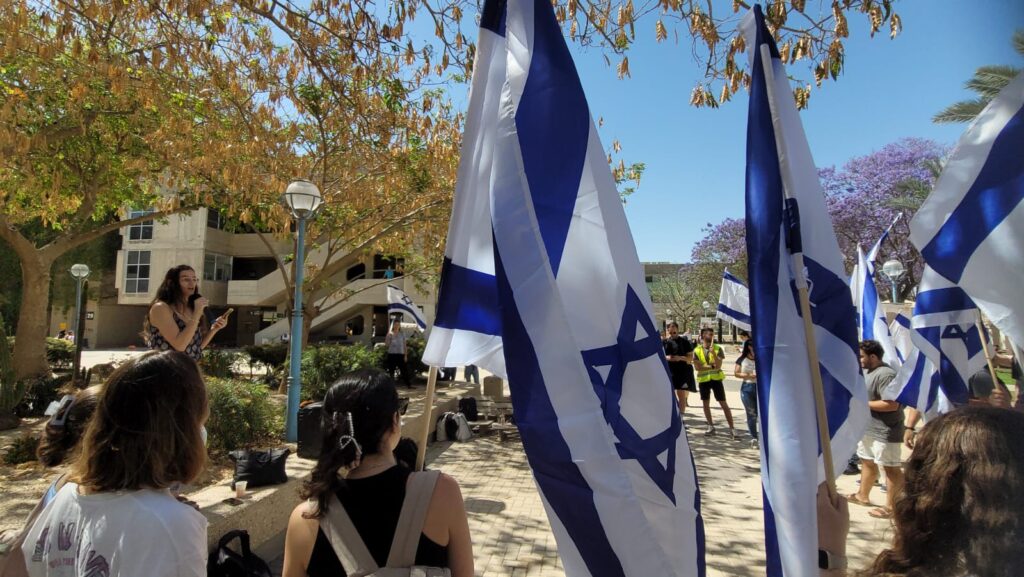
On most university campuses, Israel advocacy tends to appear in waves. When tensions rise, statements are shared, debates happen, and events fill up. But once the noise fades, so does the visible presence of pro-Israel voices. It’s easy to think that if nothing major is happening that there is nothing that needs to be said. However, I believe that this is exactly when advocacy matters most.
Quiet periods are not pauses; they are opportunities. These are the moments when a culture of honesty and factual understanding can be built before misinformation has the chance to spread. When students only hear about Israel during times of crisis, their entire perception of the country becomes framed by conflict. Proactive advocacy that highlights Israeli culture, history, and innovation throughout the year can create a more balanced understanding that helps prevent false or one-sided narratives from taking root later.
On my own campus at the University of East Anglia in Norwich, a new pro-Palestinian society has recently been established. So far, they have not organised much and they have yet to make any major controversies or statements. That might sound like a reason to wait before planning any Israel-related initiatives,but that kind of passivity creates a vacuum, and vacuums tend to get filled by the loudest voices once something happens.
For example, protests at Kings College University in London have featured genocidal slogans such as “From the river to the sea” and there was little pushback from the school let alone the Jewish community. Why did so many students feel certain and emboldened enough to participate in such a morally reprehensible event? Because when there is no visible, fact-based Israel engagement during quieter times, misinformation spreads much more easily. Posters appear, slogans circulate on social media, and myths presented as facts start shaping public opinion.
Falsely accusing Israel of being an ‘apartheid state’ and a ‘colonial project’ are frequently thrown around on social media regardless of the fact that they have been repeatedly refuted by legal and historical experts. By the time anyone tries to correct the record, it is already too late.
That is exactly why advocacy should not only be reactionary. Instead, it should be consistent, proactive, and rooted in education rather than conflict. We need to start creating familiarity with Israel that goes beyond the political lens: hosting cultural evenings, film screenings highlighting Israeli culture, and discussions on Israeli innovation and technology. Even offering informal dinners where people can ask honest questions would be helpful. These kinds of spaces build relationships and help remind our peers that Israelis and Zionists are human and deserve to have our perspectives assessed fairly.
So when a crisis does arise, people know where to find context and reliable information to develop the best informed understanding they can instead of relying on social media posts or biased misinformation online.
When students already associate Israel with diversity, creativity, and real people rather than distant headlines, they are less likely to unquestionably accept distorted claims.
It’s important to remind people that the population of Israel is one of the most diverse in the Middle East, made up of Jews from across the whole region. This includes communities from Iraq, Yemen, Morocco and Iran. As well as the Druze, Christian and Muslims who are all full citizens of the country. Despite this fact, Israel is continually misrepresented as an ethnically homogeneous foreign colonial project when the Jewish people are indigenous to the land and have maintained a continuous presence and cultural collection to the land for over 3000 years.
Recognising this historical and cultural reality is vital to counter any politicised and simplistic narratives that angry activists like to spread.
This article was originally published in The Times of Israel Blogs.