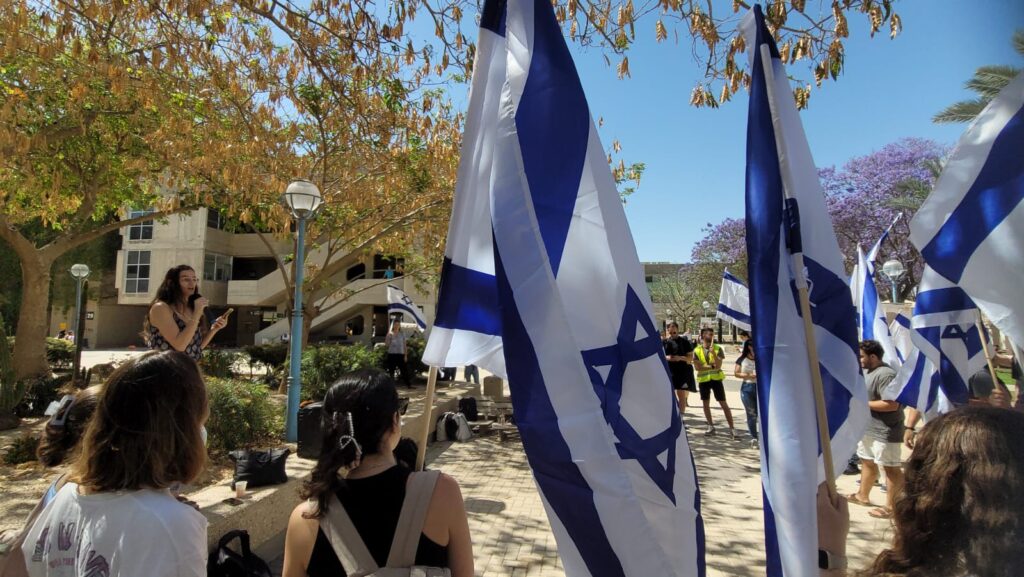
Earlier this semester, I helped host a virtual reality tabling event on campus that allowed students to step into the experiences of Israelis during the October 7th Hamas attacks. Using VR headsets, students could personally witness the devastation and chaos of that day, including scenes from the Nova Music Festival massacre. I expected emotional reactions and I saw them. But what surprised me most was how many students had never even heard of what happened.
Again and again, I found myself explaining what “Nova” was, who the hostages were, and why the VR experience existed at all. Some students didn’t know that over 1,200 people were murdered that day or how many innocent civilians were abused constantly as hostages for close to two years. This shockingly widespread ignorance suggests a deeper and more troubling reality: despite Israel dominating headlines and political/identitarian tensions running high across Florida campuses, it isn’t knowledge driving the outrage, it’s something else entirely.
A poll found that only 29% of undergraduate students said Israel was the better U.S. ally compared to 33% who chose the Palestinians, while 38% were unsure. Another study found that many Jewish college students reported avoiding expression of views about Israel on campus: 43 % avoided giving their opinion to classmates out of concern for being judged or ostracized. And yet at the same time, the angry beliefs about Israel are a dime a dozen on campuses across the country.
I see a couple different potential explanations for this. Peer pressure plays a major role. Many students simply mirror the opinions of their most vocal friends or influencers because taking a different stance feels socially risky. On campuses where identity politics run strong, having the “wrong” view can mean losing social belonging, so students often adopt whatever position is safest rather than what is most informed.
Blind empathy also shapes a lot of reactions: students hear stories of suffering and instinctively side with whoever appears to be the underdog, even when they lack context or historical understanding. Empathy without information becomes emotional reflex rather than informed compassion. Combined with underdeveloped critical thinking skills, and increasingly, a reliance on algorithm-driven-content, this produces opinions that feel passionate but rest on shaky or inaccurate foundations.
It’s not always willful. Students aren’t maliciously choosing to “tune out.” But many form opinions on Israel and the conflict through social media, where misinformation spreads faster than facts. Others simply avoid the topic altogether, afraid of saying something wrong or being labeled for asking questions. The result is a vacuum, one that bad actors and propaganda easily fill.
This lack of knowledge isn’t just a gap in world awareness; it’s a vulnerability. When students base their understanding of global issues on trending TikToks or one-sided infographics, they lose the ability to think critically, empathize deeply, or discern truth from manipulation. It leaves space for false narratives to take root, and it eradicates the kind of intellectual curiosity that universities are supposed to cultivate.
If UCF continues to allow this kind of ignorance to dominate the conversation about Israel or worse, silence it altogether, the consequences extend beyond this one topic. It normalizes apathy and misinformation as acceptable standards. It makes our campus less informed, less compassionate, and less prepared to confront complex global realities.
UCF can take steps to change by making space for education through moderated discussions, speaker events, and offer cross-cultural programming that encourages students to learn before they post, share, or shout. Student organizations should actively collaborate to promote honest dialogue rooted in empathy and evidence instead of reinforcing tribalistic echo chambers.
My experience was both discouraging and motivating. The lack of awareness was alarming, but the curiosity that followed gave me hope. Students brave enough to learn lingered after watching and asked questions. Many expressed appreciation for access to something real and not filtered through a screen or an algorithm. They wanted to understand.
Growth and awareness begins with a single conversation.
This article was originally published in HER Campus.