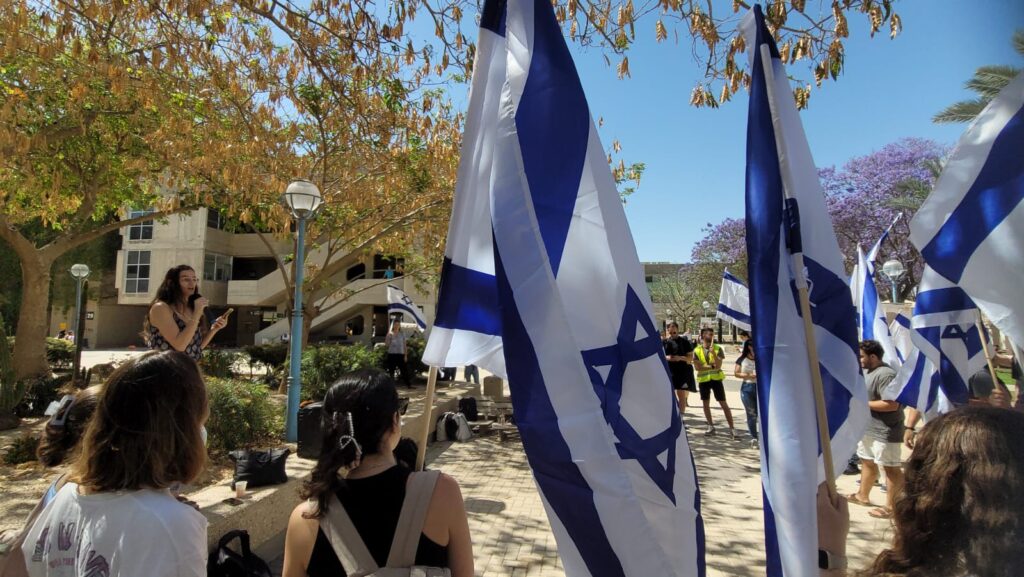
Anti-Zionist organizations and activists often amplify Jewish voices on their side to give the appearance that they cannot be antisemitic. Token anti-Zionist Jews are often used to sideline Zionist Jews’ concerns about the rise of antisemitism related to anti-Zionism.
We often see “not in our name” or similar slogans displayed front and center in anti-Zionist rallies and on social media. Anti-Zionist Jewish groups like Jewish Voice for Peace (JVP) and If Not Now march alongside antisemitic groups like Students for Justice in Palestine and BDS, and their hateful rhetoric about Israel is almost indistinguishable.
Recently, JVP activists held a protest at New York City Hall against a bill that would require buffer zones for protests in front of houses of worship. This bill would protect synagogues from antisemitic protests, which is a reasonable response to recent antisemitic incidents. By protesting this bill, anti-Zionist Jews are trying to dictate how the Jewish community should react to antisemitism.
But this problem is not limited to only the far left. The ultra-Orthodox Neturei Karta are also seen protesting at many rallies. The Neturei Karta are a fringe sect of Jews who associate with antisemites and terrorists, and repeatedly attend the Holocaust denial conference hosted by the Islamic regime in Iran. Despite their appearance of religious authority, every other Orthodox sect regularly condemns them.
It’s also worth noting that anti-Zionist Jews make up a small minority of the American Jewish population. By amplifying the voices of these token Jews, non-Jewish anti-Zionists attempt to justify their hateful and discriminatory rhetoric because it allows them to falsely suggest that their hatred of Israel has nothing to do with antisemitism. It also allows them to claim antisemitism as purely a problem of the far right and ignore the problem of antisemitism in the far left and anti-Israel movement.
This has further contributed to a false impression that rising antisemitism is not a real concern and that accusations of antisemitism should be ignored, hindering support for Jewish communities that face actual threats to our rights and safety. When people who want to support Jews only listen to anti-Zionist voices, they obtain a distorted view of the issues facing our community.
Tokenization is not only a problem in higher education and student activism, but it also affects our ability to fight antisemitism in politics. NYC Mayor Zohran Mamdani led a campaign where he refused to condemn “globalize the intifada,” a slogan that calls for violence against Jews worldwide.
Many of his early appointments are more explicitly antisemitic. Mamdani’s director of appointments, Catherine Almonte Da Costa, resigned over antisemitic tweets that referred to Jews as “rich Jewish peeps” and “money hungry.” Another appointment was Chief Counsel Ramzi Kassem, who wrote anti-Zionist articles and defended activist Mahmoud Khalil. Despite all of this, he has many vocal Jewish supporters and has even been welcomed by Satmar Chassidim.
On his first day in office, Mamdani revoked the adoption of the IHRA definition of antisemitism and anti-BDS measures, essentially barring anti-Zionist hate crimes and discrimination from being considered antisemitic. Mamdani stated that conflating anti-Zionism and antisemitism “draws attention away from the very real crisis of antisemitism.”
However, this ‘crisis’ did not develop in isolation but is linked to anti-Zionist rhetoric that portrays Jews as agents of genocide. By sidelining Zionist voices, Mamdani weakens the Jewish community’s ability to combat antisemitism effectively.
As Zionist Jews, we must remind the world that we are the majority and represent the Jewish mainstream position. To effectively fight antisemitism, we need to clearly define our position and state that anyone advocating for violence or discrimination against Jews can be antisemitic, regardless of their Jewish identity.
Orthodox Jews in particular need to make it clear that the Neturei Karta are extremists and harbor views universally rejected in Orthodox Judaism. We must be able to assert proudly that the belief in our right and duty to our ancestral homeland is not only political, but deeply ingrained in our religious heritage.
This article was originally published in Yeshiva University’s YU Commentator.