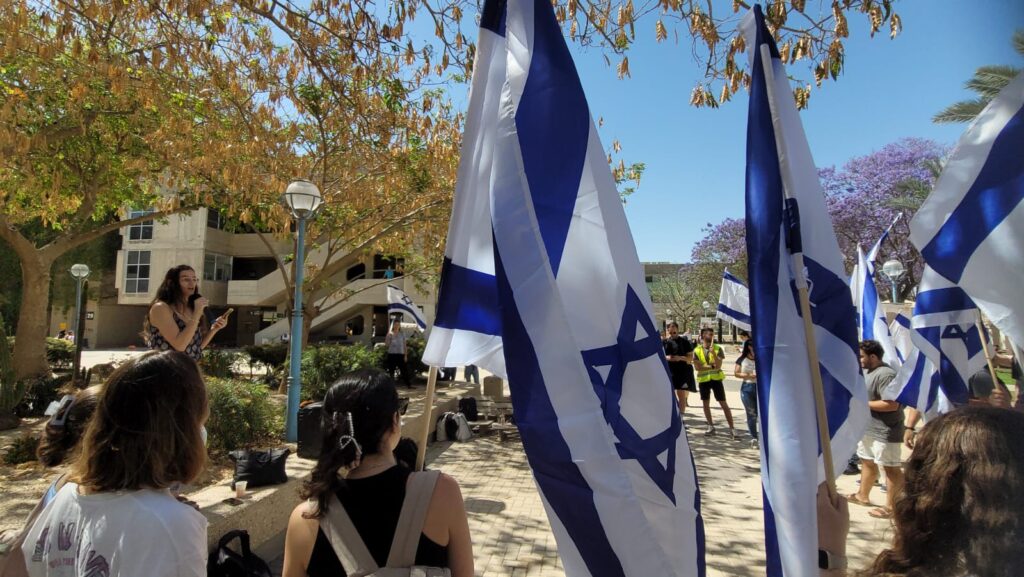
On my campus at the University of Birmingham, like many others across the UK, Jewish students are caught in an impossible position. Speaking up about Israel can invite hostility, while staying silent brings its own pain. The fear does not always come from lecture-hall debates or protests; it is the quiet uncertainty of everyday life. It is wondered whether what you say might make you a target, or whether your Jewishness will be viewed through a political lens rather than as an ethnoreligious identity. The reality is that letting this fear keep us silent has only made things worse.
The reality is stark. The major Jewish charity in the UK has focused on security reports that antisemitic incidents have surged considerably since 2023. In the first half of 2025 alone, 1,521 incidents were reported, with the Union of Jewish Students describing the situation as ‘the worst campus antisemitism crisis in a generation’.
Over the past year, I’ve come across countless stories of Jewish students being bullied, harassed, and isolated; not for anything they have done, but for who they are or what others assume they believe. Anti-Israel sentiment, like what we saw at the University of Sydney, where Jewish students were called ‘parasites’ by their own academics, has increasingly become a pretext for intimidating or alienating Jewish peers. This problem is compounded when universities fail to enforce their own codes of conduct.
Each instance of unchecked harassment sends a clear message: such behavior is acceptable and Jewish students should endure it quietly.
Within Jewish communities on campus, self-censorship has become the norm. Students describe hiding their identity or avoiding conversations simply to complete their degrees without trouble. Others no longer attend Jewish Society events or avoid wearing visible Jewish symbols in public. These are students who arrived at university eager to learn and grow, yet now find themselves calculating risk before expressing something as simple as pride in who they are.
There are concrete reasons for this fear. At the University of Birmingham, banners reading “Zionists off our campus” were displayed. At City St George’s, staff have been harassed for expressing connections to Israel, and Jewish student residences have even applied for extra security measures due to a surge in antisemitic incidents. At UCL, a student reported being told at a welcome fair that “Hamas is not a terrorist organization,” and that “October 7 was justified”. When she complained, a university caseworker initially responded that the remarks “did not amount to a disciplinary offense”.
Incidents like these reinforce the message that Jewish students’ concerns are secondary and their freedom of expression is conditional.
It’s important to say that this fear is understandable. In the face of targeted abuse, peer exclusion, and social pressure, remaining quiet can feel like a form of self-preservation. Institutional inaction deepens this fear: when codes of conduct are inconsistently enforced, raising concerns can feel futile. Yet silence, however understandable, allows the problem to deepen. It emboldens those who would prefer Jewish students to remain invisible and teaches future students that safety can only be found in hiding, a message no university should send. The fact that Jewish students are forced to choose between authenticity and safety shows how far campus culture has drifted from its stated values.
Universities must take this more seriously. Freedom of expression cannot exist when an entire minority of students feels unsafe participating in campus life. Institutions have clear obligations, their own codes of conduct, and the IHRA definition of antisemitism to guide them. These frameworks only matter if applied consistently.
When harassment occurs, it must be met with clear and enforceable consequences, including the de-registration of student groups that promote or endorse violence, as well as suspension or expulsion for students who participate. Turning a blind eye reinforces the idea that Jewish students’ safety is negotiable.
But that’s half the battle. Jewish students must be proud, standing firm with our values and the truth. No one is asking for special treatment. Campus activism is already highly politicized and often dominated by loud, one-sided voices, yet Jewish students have the same right to participate as anyone else.
History has shown that silence is not a form of protection. Small acts of courage, such as attending events, respectfully challenging misinformation, and wearing a Magen David openly, will shift the atmosphere.
The goal is not confrontation, but visibility. It is unreasonable to be treated as if being openly Jewish or expressing a mainstream connection to Israel is a provocation. People need to be reminded of this.
Advocacy is not about winning arguments; it is about demanding the right to exist, speak, and belong without fear of persecution or harm. When Jewish students find their voices again, we will not only change campus culture, but we will remind everyone that silence was never our story.
This article was originally published in the Times of Israel Blogs.