Sometimes a moment doesn’t only shock us – it gives shape to feelings we’ve carried quietly for far too long. For Jewish students, the room to be visible and unafraid has been narrowing, and recent events have made that truth impossible to look away from.
The Yom Kippur attack in Manchester was not only a profound shock to the local Jewish community but to Jews around the world. On October 2, 2025, during the holiest day in the Jewish calendar, a terrorist drove a car into worshippers outside the Heaton Park Hebrew Congregation synagogue before stabbing several individuals, resulting in two deaths and multiple injuries. The victims, 53-year-old Adrian Daulby and 66-year-old Melvin Cravitz, were cherished members of the community.
At the University of Exeter, almost five hours away, the Jewish community felt the impact of this heinous crime. Conversations I’ve had with fellow students revealed that many no longer feel safe attending events, let alone expressing their Jewish identity or connections to Israel.
Most said that the Manchester attack had a big influence on how secure they felt, even though some experienced concerns even before. Families that once encouraged openness now urge caution, and gestures of cultural pride are being replaced by the quiet calculation of personal risk.
The space for visible Jewish identity on campus – and in public life more broadly – feels smaller than it once was, raising urgent questions about belonging, safety, and the limits of expression on university campuses.
Even before the attack, there were already hesitations and whispers in our community about safety concerns in associating with the Jewish or Israel Society on campus.
Frequent protests that were held in the main building of the university, an attack on an Israel Society stall that happened in 2024, pop-up encampments designed to intimidate; all of which had an impact on Jewish students. This prompted a group of students, including myself, to create and run a survey on safety among Jewish students.
Of the thirty students in the University of Exeter Jewish Society, twenty-five responded to the survey. What we found was deeply troubling: more than half of the respondents felt unsafe attending Israel-related events. Alarmingly, 95% of the students who filled out the survey fear admitting having any connection to Israel, and 80% of students hide their Jewish identity when talking to people on campus.
I can share firsthand that fearing to share my heritage and culture is an awful experience. It creates barriers to making friends and forces students like me to live in constant fear of whom we can trust.
I started my first year of university in September 2023, just three weeks before the Hamas led massacre. Instead of being supported by my non-Jewish friends, I faced the hate that was solely based on my identity and my connection to Israel. People I might have called friends hurled comments like these at me: “You and your family deserve it”, “You should have been there and dead”, and “I love being friends with you, but I am Muslim, so I will never support you.”
Their words silenced me, discouraging me from even trying to make new friends for the entire first term. It turned my life into a constant exercise in scanning every room, trying to figure out who might actually listen to me instead of blaming me for events in a far away conflict.
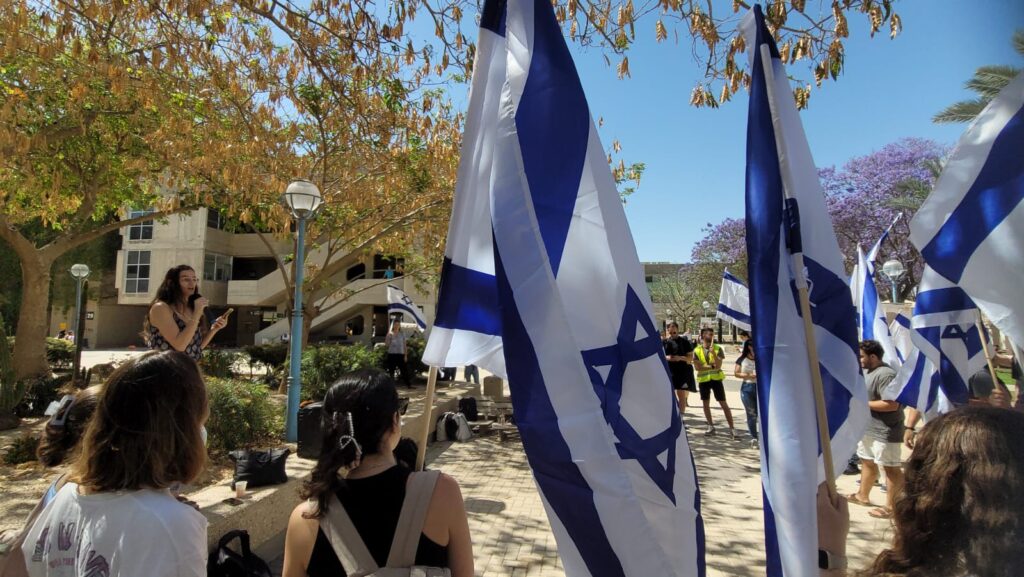
The Manchester attack amplified these existing fears. Five days later, on the 2nd commemoration of the Hamas-led Massacre in Israel, the Israel Society committee, including myself, set up a stall to commemorate the hostages.
We hoped Jewish students would join us in solidarity, but the turnout was disheartening; only about 10 people showed up, quite a small fraction of our community. It’s hard not to see how fear kept so many away.
The survey numbers were sobering, and the turnout at the memorial stall on 7 October 2025 made it painfully clear – only a handful of us were there, when there should have been dozens.
For me, those first three months of university taught me one thing I’ve never forgotten: the prouder I am of being Jewish and of my connection to Israel, the less fear gets to dictate my life. It’s not about pretending the danger isn’t real. It’s about refusing to let it shrink who I am. Every time I walk into a society event, speak openly, or just wear my identity without apology, I take back a little of what hate tried to steal.
This isn’t over. The fear is real, the numbers don’t lie, and the empty spaces at our events speak for themselves. But so does the fact that we’re still here – still showing up, still speaking, still Jewish. And as long as we keep choosing pride over silence, fear doesn’t get the last word.
This article was originally published in Jewish News.