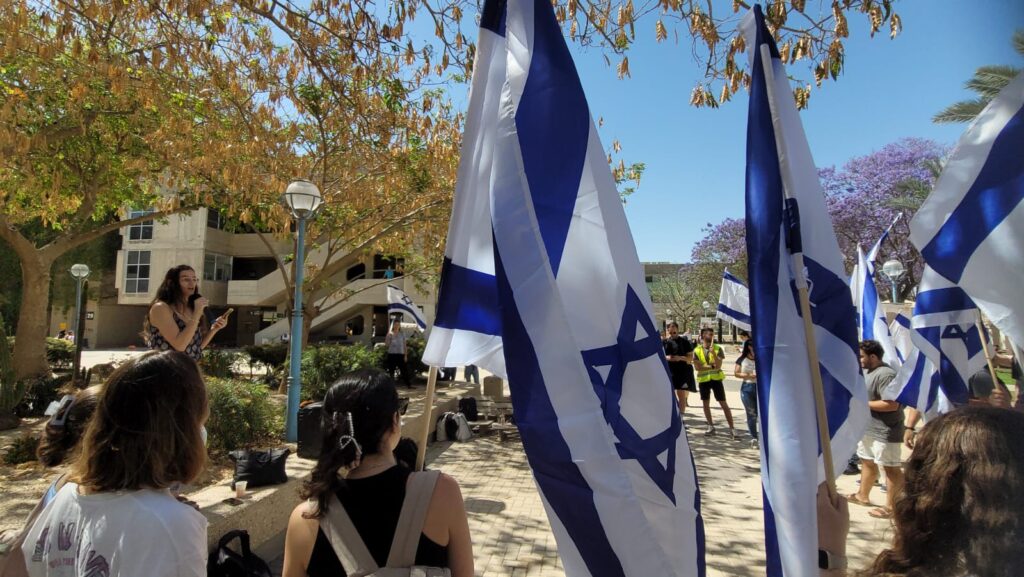
In February 2026, a university screening at King’s College London required an astonishing level of security: 30 police officers and 15 professional security personnel for 20 students and five members of the university’s staff.
The reason? A 47-minute film of raw footage from the October 7, 2023, Hamas attack was screened, showing what actually happened that day.
An earlier attempt by the local student Israel Society to hold the screening had been abandoned entirely because the university didn’t grant permission on security grounds.
Outside of the event, protesters from the university’s Students for Justice in Palestine chapter chanted “Get the Zios off campus.”
Jewish students must operate behind visible layers of protection simply to gather, pray, eat, or learn together. Activities that were once routine campus activities now demand the same level of protection more commonly associated with high-profile political events, raising serious questions about what the campus “normal” has become.
As someone who has experienced this situation firsthand, the heavy use of security is not symbolic. It reflects real, credible threats of disruption and intimidation that have already forced events to be cancelled.
Jewish students now require visible police protection for activities that every other group takes for granted — a film screening, a cultural night, a Shabbat dinner. This is not discomfort; it is unequal access to campus life. The activism that claims to defend the vulnerable has instead made Jewish students the ones who need defending.
The reason stories like these keep happening is clear and uncomfortable: Anti-Zionism has increasingly become the dominant expression of discrimination and bigotry against Jews on campus. What commonly presents itself as “political criticism of Israel” quickly turns into intimidation, harassment, and exclusion regardless of any individual Zionist-identified individual’s views.
Universities that continue to outsource safety to police cordons while wringing their hands about “tensions” are simply managing symptoms. They are not addressing the root cause.
Chants that single out “Zios,” accusations of collective guilt, and the assumption that any Jewish event is somehow provocative have turned Jewish identity into a liability. This is not abstract theory. Jewish students report being chased, threatened, verbally abused, and physically targeted simply for being visibly Jewish or Israeli. Many now hide Stars of David, stop speaking Hebrew in public, or avoid Jewish spaces altogether to stay safe.
And what happened at my school is happening to students all over the UK. The Union of Jewish Students’ March 2026 national polling of 1,000 students found that nearly a quarter had witnessed behavior specifically targeting Jewish students for their religion or ethnicity. The poll also found that 77% of those who see Israel-Palestine protests regularly witnessed slogans or chants directly justifying the October 7 attack.
The pattern is consistent: hostility that begins with Israel is commonly expressed through hostility toward the nearest Jews who don’t actively identify as anti-Zionist, and those who attempt to humanise the Jews of Israel. The political rhetoric saying “it’s only about Israel” is just a disguise.
This situation is bad for Jewish students, but it is also corrosive for universities themselves. When institutions must essentially militarize everyday student activity to keep one minority safe, they have already failed their basic duty to provide an equal learning environment.
Free speech is not the issue here. Protest and legitimate criticism of any government must be protected. However, what should not be protected is the right to harass, intimidate, or exclude Jewish students under the guise of activism. Distinguishing between the two is a key element of the widely accepted IHRA Working Definition of Antisemitism.
Universities know what needs to be done. Our leaders have been telling them for years. First, enforce existing codes of conduct without hesitation whenever harassment or intimidation occurs, without selective blindness or “context” excuses that only apply to Jews.
Second, apply free speech rules equally. Disruption that prevents Jewish students from accessing events or education is not protected speech; it is a violation of rights.
Third, publicly rebuke the notion that pro-Israel events are inherently provocative. A Shabbat dinner is not a political statement. A screening of actual footage is not a provocation.
These activists will wrongly argue that enforcing such policies amounts to censorship. But in Western civilization, nobody is free to do whatever they want, regardless of their effect on others. They are free to voice their opposition, but not to impose it on others.
Curtailing this behavior is the minimum requirement for any university campus and a healthy community.
A “fortified” campus is not a solution — it is an admission of failure. Until universities confront the reality that anti-Zionism produces the same result as antisemitism, Jewish students will continue to need physical protection to live normal student lives.
The question is no longer whether this climate exists; it’s whether university leadership — including at King’s College — has the courage to act on it.
This article was originally published in The Algemeiner.